The Stable
· scores ch-02, ch-05 · verdict: confirms
Five Hundred and Fifty-Nine Million
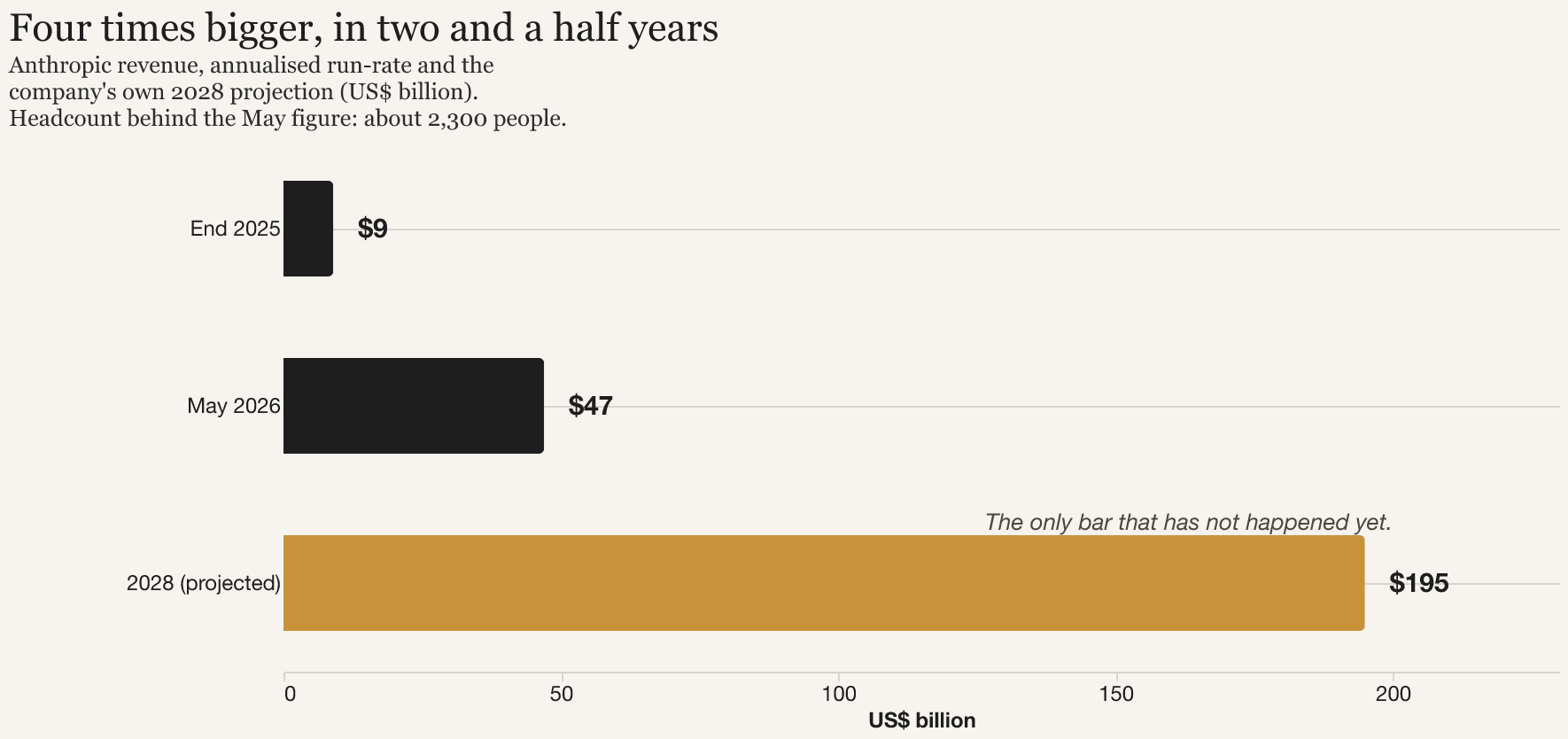
Reuters reported on 14 August that Anthropic is projecting revenue of roughly 190 to 200 billion dollars for 2028, a figure two people familiar with the company's financials described as the anchor for its eventual listing. The progression behind it is the part worth writing down. The annualised run-rate was about 9 billion dollars at the end of 2025 and 47 billion dollars by May 2026, and it has grown more than tenfold annually in each of the three years through early 2026. In the second quarter of 2026 the company is projected to have booked at least 10.9 billion dollars of revenue and 559 million dollars of operating profit.
The headcount that produced the May figure was approximately 2,300 people at the end of 2025 on Fortune's reporting, with trackers putting it somewhere between that and three thousand through 2026. The company does not publish the number.
The claim on the table
The ledger's micro-giants claim holds that the link between headcount and value is collapsing, that firms with small staffs and enormous revenues are the template rather than the exception, and that revenue per employee is the metric to watch. It is confirmed by rising revenue per employee at the frontier and complicated by AI-native firms that scale headcount in step with revenue.
The number the book already used, moving
Chapter 2 opened on this company for a reason: at 47 billion dollars of run-rate against roughly 2,300 to 3,000 people, the implied ratio is somewhere between sixteen and twenty million dollars per head, an order of magnitude beyond what the broader economy lives by. Walmart runs at roughly a quarter of a million dollars per employee. Boeing manages a little over four hundred thousand.
The 2028 projection does not politely extend that line; it bends it. Reaching 190 billion dollars of revenue in calendar year 2028 requires roughly a fourfold expansion on the mid-2026 annualised run-rate, inside two and a half years. Whether the ratio moves with it depends entirely on a number the company declines to publish. If headcount doubles, revenue per head still roughly doubles. If it quadruples, the ratio holds flat and the frontier lab starts to look like an ordinary large employer that happens to sell software.
That is the useful thing about this entry: it converts a thesis into a countable test with a date on it.
The caveat that is starting to move too
Chapter 2 was careful not to claim the frontier labs are true micro-giants. Their high revenue per employee was described there as a temporary artefact of two things: revenue compounding faster than headcount during a take-off phase, and net margins running deeply negative because of compute capital expenditure. The chapter's conclusion was blunt. The headcount-revenue link has not broken at the frontier-model labs; it has been traded for capital depreciation, with the labour relabelled as GPU, data centre and training run on the balance sheet.
A projected operating profit of 559 million dollars in a single quarter is the first public number that presses on that caveat. It is not proof that the artefact has become a structure. It is one quarter and it is projected rather than filed. An operating-profit line also says less about compute than it appears to: the cash spent building and buying capacity lands on the cash flow statement rather than in that number, and rented capacity can spread the cost of infrastructure across years instead of recognising it now. But the book's hedge assumed the deep negative margin would persist through the take-off, and this figure says it may not persist as long as assumed.
The honest hedge
Almost everything here is a projection attributed to anonymous sources ahead of a listing, which is the least reliable genre of financial number in existence. Companies preparing to go public have every incentive to circulate a flattering forward figure, and a 2028 revenue forecast made in 2026 carries no obligation to be met. The run-rate figures are also run-rates, which is to say a recent month annualised, not realised revenue for any completed year.
The follow-up condition is unusually clean, and it is why this entry exists rather than waiting. Anthropic's S-1, whenever it is filed, will contain audited revenue, audited margins and, for the first time, an actual headcount. Every number above becomes checkable on that day. If the filing shows headcount scaling in step with revenue, this entry gets a correcting update and the claim is complicated rather than confirmed.
Why this confirms
Because the metric the claim tells us to watch moved, and it moved in the direction the claim predicts, at a company that is currently the clearest instance of the pattern. A firm on the order of two to three thousand people is projecting revenue that would place it among the largest companies on earth, and it is doing so while telling investors its valuation should be read against forward revenue multiples of forty to fifty times, the arithmetic of software rather than of employment.
What is confirmed is a direction of travel, priced by a private market that is currently willing to pay for it. It is not an audited outcome, and it holds only until the S-1 either substantiates the trajectory or corrects it.
There is a second thing worth naming, because the ledger is not only about the metric. An initial public offering is the precise moment at which ownership of an asset is distributed. When this one happens, the shares will go to institutions, to funds and to the investors who were already inside. The public whose research funded the underlying architecture, whose data trained the models and whose taxes built the scientific base will be able to participate in exactly one way: by buying in afterwards, at forty to fifty times revenue, once the value has already formed.
So the window this ledger keeps watching is open here in its most literal form. The asset is being priced, the rules of its ownership are being written this year, and the question the book keeps returning to is the only one that will still matter in 2028: who owns the machine?
Sources
- Reuters (Echo Wang), reporting the 2028 revenue projection of roughly 190 to 200 billion dollars on two people familiar with the company's financials, the run-rate progression from about 9 billion dollars at the end of 2025 to 47 billion dollars in May 2026, second-quarter 2026 revenue of at least 10.9 billion dollars and operating profit of 559 million dollars, and the comparable forward multiples for Palantir, SpaceX and Cloudflare: Anthropic IPO valuation hinges on 190-200 billion 2028 revenue forecast, sources say (14 August 2026)
- Fortune, the anchor for the headcount figure the book uses (approximately 2,300 employees as of December 2025; Anthropic does not publish official headcount, and tracker estimates run higher through 2026)