The short version
You used to do the work yourself: it was in your hands and in your head. Now a machine does it, and the machine belongs to someone. So who is that someone, and what becomes of the rest of us?
That is the question of the full book, and it is the question of this short version. This edition exists because the argument matters more than the sales. It is free, and it is written for people who are worried and do not have time for 400 pages.
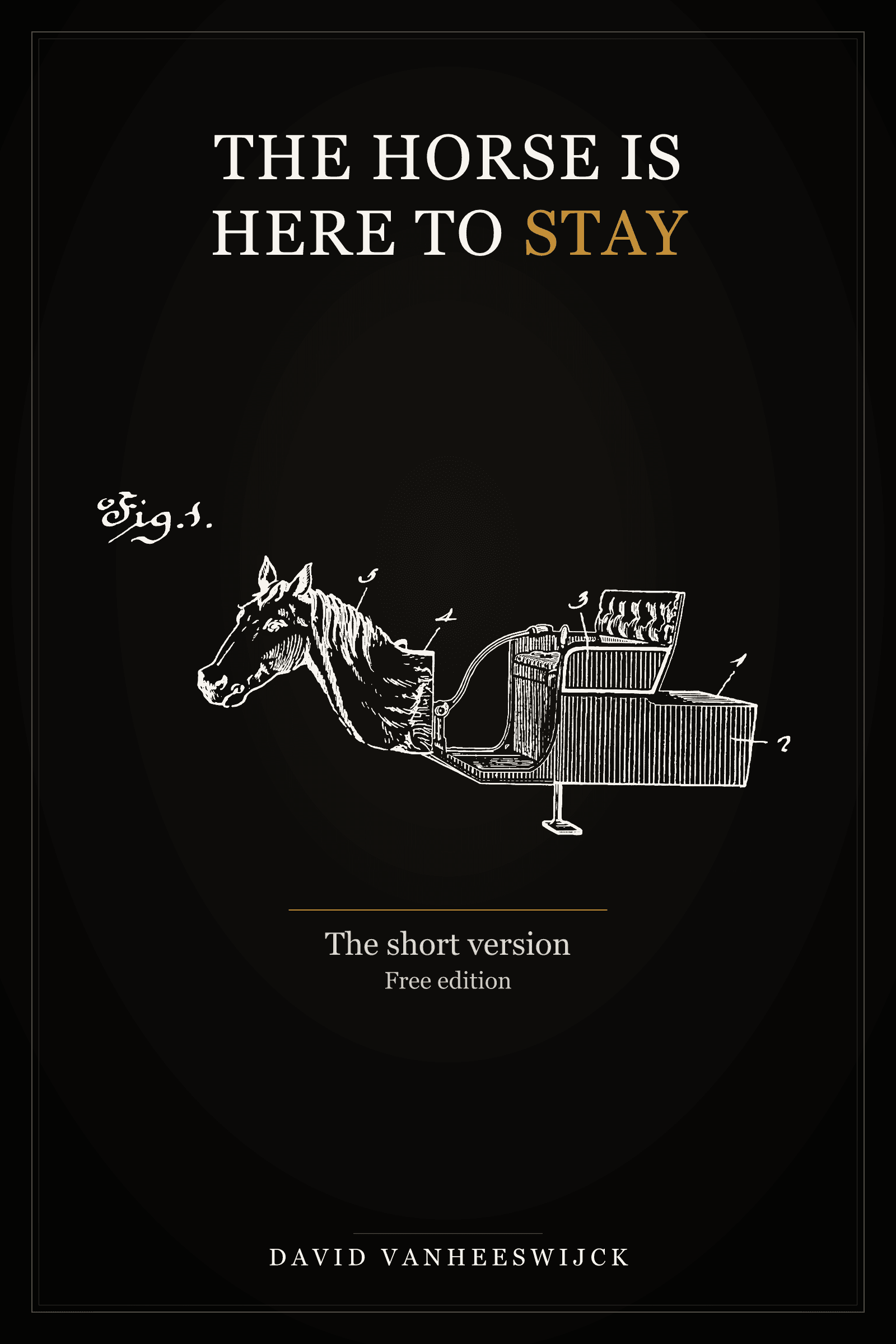
The horse of the title came into the argument in 1983, when the economist Wassily Leontief warned that what the engine had done to the horse, the coming machines would do to human labour. The horse could not own a slice of the Ford Motor Company and could not vote. We can do both. Everything in this book turns on that difference.
What this edition is
The same book, shorter
Preface, thirteen chapters and the conclusion, each cut to about a third. One claim and one story per chapter: the dark factory in Changping, the tea plant in Gémenos, the Alaska cheque, the Norwegian fund. Every figure comes from the full book or the sources it cites, and each chapter ends with a short list of where its facts come from.
Plain words
Written for a reader who is good at their own job, follows the news and never studied economics. Nothing is explained that you already know. The trade words that had to stay are explained once, as a picture, not a dictionary entry.
Free, and it stays free
Licensed so you can copy it and pass it on, as long as you name the author, do not sell it and do not change it. The most useful thing you can do with it is give it to one other person.
The chapters
- Preface · The horse, Leontief, and the question the book carries through every chapter.
- 1Who Stole the Gains? · A factory that runs with the lights off. When a machine produces more, the extra goes to whoever owns the machine.
- 2Micro-Giants · A company worth more than a country produces in a year, with a few thousand employees. The link between revenue and jobs does not bend. It breaks.
- 3The Cognitive Labour Cost · The experience went into the model. Nobody who filled it was paid.
- 4The Great Decoupling · Fifty years of rising productivity and flat pay, and why AI finishes the job.
- 5The Capital Republic · Why the gains cannot come back through wages, and where they go instead.
- 6The Architecture of Access · Who can buy a piece of the frontier, and who is kept out by design.
- 7Hacker's Word · Predistribution: owning a share before the gains settle, instead of taxing them after.
- 8Norway and Alaska · Two countries that did half of it each: one holds the fund, one pays the cheque.
- 9The Bebchuk Trap · What goes wrong when the public owns shares and nobody is allowed to feel it.
- 10When the Market Falls · The honest objection: a stake is worth less in a crash, and what the design does about it.
- 11The Positional Trap · A dividend buys the floor, not the view. Why that is a strength.
- 12Keynes's Mistake · The fifteen-hour week that never came, and what it teaches about forecasts.
- 13Identity Without Income · A cheque solves the rent. It does not solve Tuesday afternoon.
- Conclusion · Against prophecy and for design. The horse is here to stay. So are we, if we own the stable.
The full book
This short edition is drawn from The Horse Is Here to Stay: Work, Wages, and Human Purpose in the Age of Intelligent Machines, published in August 2026. The full book has the same argument with all its evidence: the footnotes, the second and third examples in each chapter, and the arguments this edition leaves out. Paperback, hardcover, ebook and audiobook.
David Vanheeswijck
David Vanheeswijck builds AI systems for a living. For nearly thirty years he wrote the code that made a Monday's work disappear before anyone arrived to do it. This book comes from that ground floor, not from a lecture hall.
The Horse Is Here to Stay: The Short Version. First edition, 30 September 2026. Published by David Vanheeswijck. Licensed under Creative Commons Attribution-NonCommercial-NoDerivatives 4.0 International. Prepared with the help of AI systems working under the author's direction; the judgement, and any errors, are the author's. Corrections and comments: book@vanheeswijck.com.