The Stable
· scores ch-04, ch-05 · verdict: confirms
Fifty-Two Point Nine
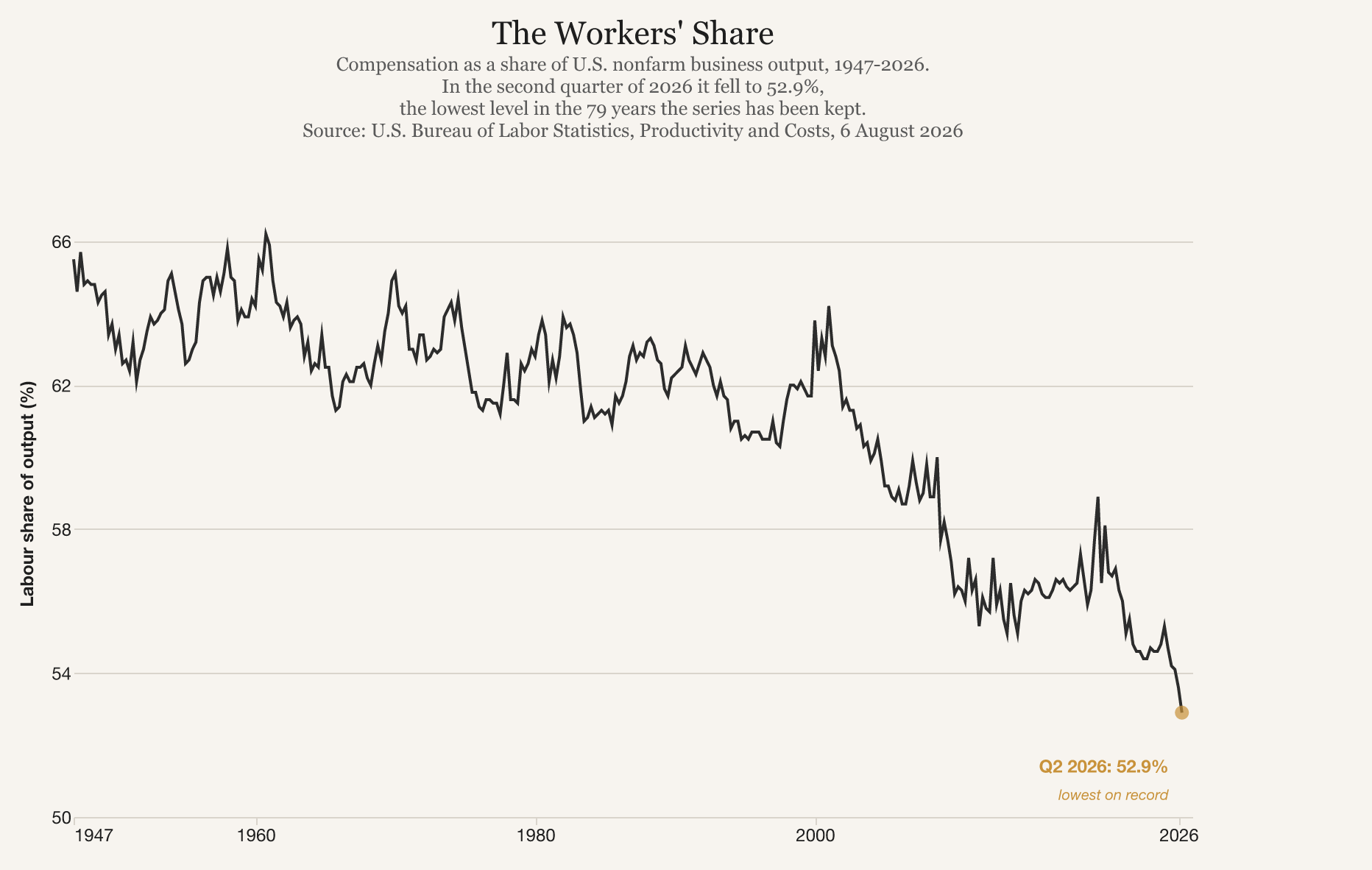
On 6 August the US Bureau of Labor Statistics published its preliminary productivity figures for the second quarter of 2026. One sentence in the release does most of the work: "The labor share, which is the percentage of output that accrues to workers in the form of compensation, was 52.9 percent in the second quarter of 2026, the lowest level in the series which begins in the first quarter of 1947." Seventy-nine years of measurement, and no quarter in which American workers kept a smaller share of what American business produced.
The rest of the release fills in the mechanism. Labour productivity rose 1.4 per cent in the quarter and 2.2 per cent over the year. Output rose 1.7 per cent on hours up just 0.3 per cent. And real hourly compensation, pay adjusted for what it buys, fell 3.1 per cent in the quarter and is down 0.1 per cent over the last four quarters. More output per hour, from barely more hours, for pay that buys slightly less than it did a year ago.
The claim on the table
The labour-share claim (chapters 4 and 5) says the split between productivity and pay is real, global and ongoing: the share of income going to labour keeps trending down, and AI accelerates the mechanism rather than inventing it. The book spends a chapter on the fifty-year version of this chart. What the ledger watches for is whether the line keeps moving now, in the adoption years, or whether it flattens and embarrasses the argument. On 6 August the line moved, to a place it has never been in the history of the series.
A record without a press conference
What makes this entry easy to write is what the release does not say. There is no AI narrative in it, no interpretation, no adjective. It is an accounting identity published on a Thursday at 8:30 in the morning: productivity up, real pay down, labour share at a floor never previously printed. The book's argument has always been that the decoupling does not arrive as a dramatic event but as a compounding statistical drift that no single quarter announces. This is what that looks like from inside the drift: a record that made no front pages, in a series most people have never heard of, measuring the thing the whole argument is about.
The deflator debate from chapter 4 is worth recalling here, because it does not rescue the orthodox reading. That debate turns on price indices: critics of the productivity-pay chart argue the gap is partly a statistical artefact because pay is deflated with consumer prices while output is deflated with producer prices, and adjusting both to a common measure shrinks the divergence. Whatever one makes of that argument, it has purchase on some of the figures above, the real compensation numbers pass through a consumer price index, but none at all on the headline. The labour share is a ratio of nominal compensation to nominal output; no deflator enters that calculation. This is the cleanest of the decoupling measures, the one the methodological fight cannot touch, and it just printed its lowest value on record.
The honest hedge
One quarter is one quarter. This is a preliminary estimate, revised on 3 September, and the labour share is a volatile series that has printed local lows before, drifting down through them for decades. A record print extends the trend; it does not accelerate it, and nothing in this release attributes anything to AI. The claim's stronger clause, that AI speeds the mechanism up, cannot be settled by a single quarterly figure and this entry does not pretend otherwise. If the September revision moves the number materially, this entry gets a follow-up saying so.
Why this confirms
The claim asserts a direction, and the ledger scores direction against data. The most direct official measure of how output divides between labour and capital, maintained by the US government since 1947, reached its lowest recorded level in the quarter in which the AI build-out ran at full speed, while productivity in the same release grew above its long-run average. Workers produced more; their share came back smaller. That is not a forecast, a vibe or a think-piece. It is the book's central chart, extended by one more point, in the direction the book said it would go. And it sharpens the standing question rather than settling it: if 47.1 per cent of everything American business produced last quarter accrued to something other than labour, then the question that matters was never whether the machine takes your job. Who owns the machine?